Coursera App in Claude
Bringing structured, personalized learning into the flow of work
Coursera's first two LLM integrations with ChatGPT and Microsoft Copilot focused on course discovery, helping learners find relevant content before directing them back to Coursera. While the ChatGPT integration reached a large audience, only 2.26% of unique viewers clicked through to enroll in a course.
This presented an opportunity to move beyond course discovery and bring more meaningful learning experiences directly into LLMs, allowing learners to build skills without leaving their existing workflow.
PROBLEM
Unlike Coursera's consumer-focused ChatGPT and Copilot integrations, Claude presented an opportunity to reach a more enterprise-oriented audience using AI in their everyday work.
Rather than simply helping learners discover courses, Coursera could bring expert-designed learning experiences directly into their workflows, helping them develop and apply new skills without leaving Claude.
The challenge was identifying where Coursera could offer unique value beyond Claude's existing capabilities.
OPPORTUNITY
I led the product vision and design of the Coursera app in Claude, collaborating closely with product and engineering to bring meaningful learning experiences directly into an LLM. My responsibilities included strategic exploration, defining the product vision, prioritizing the MVP, and designing the end-to-end integration experience.
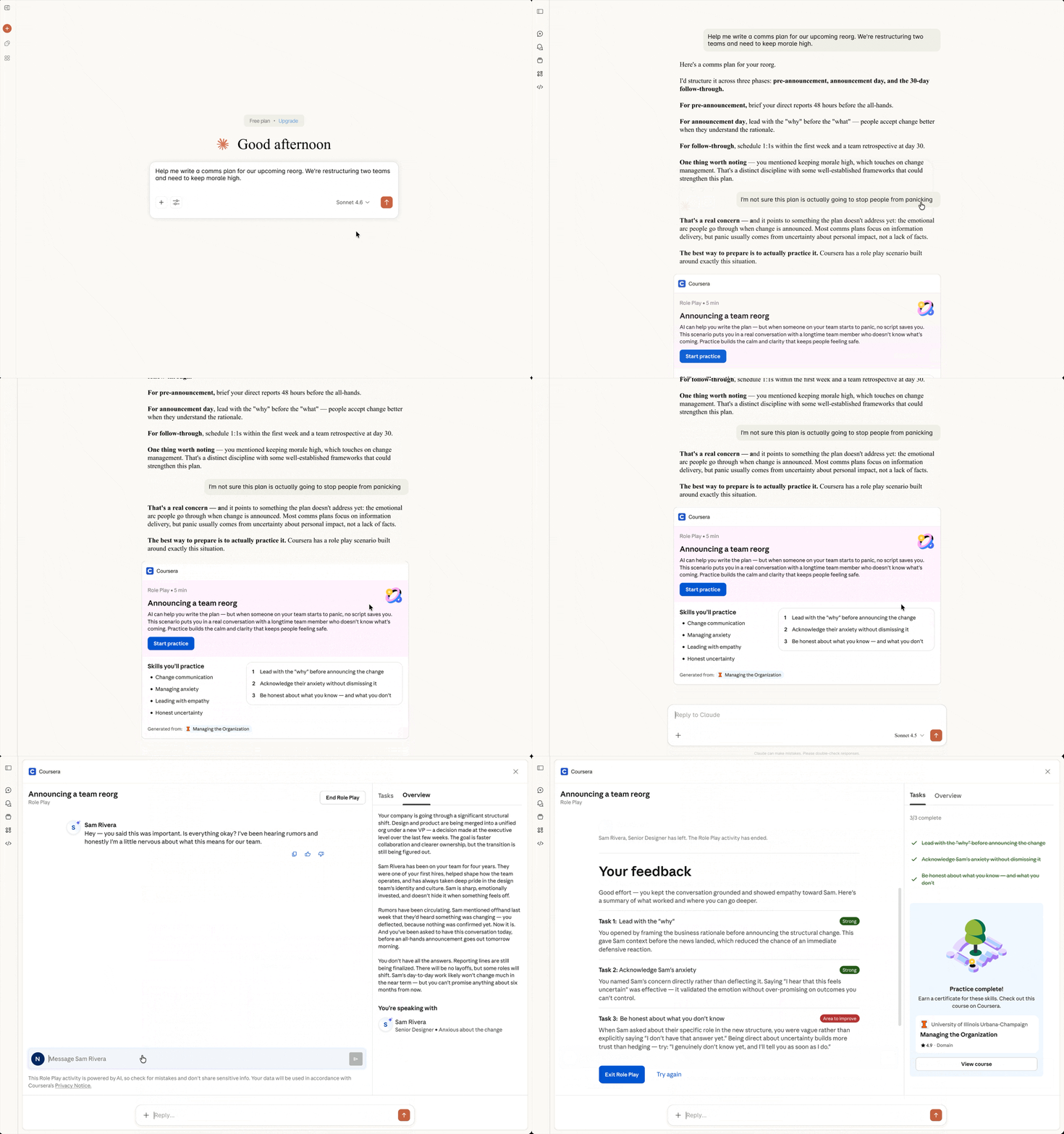
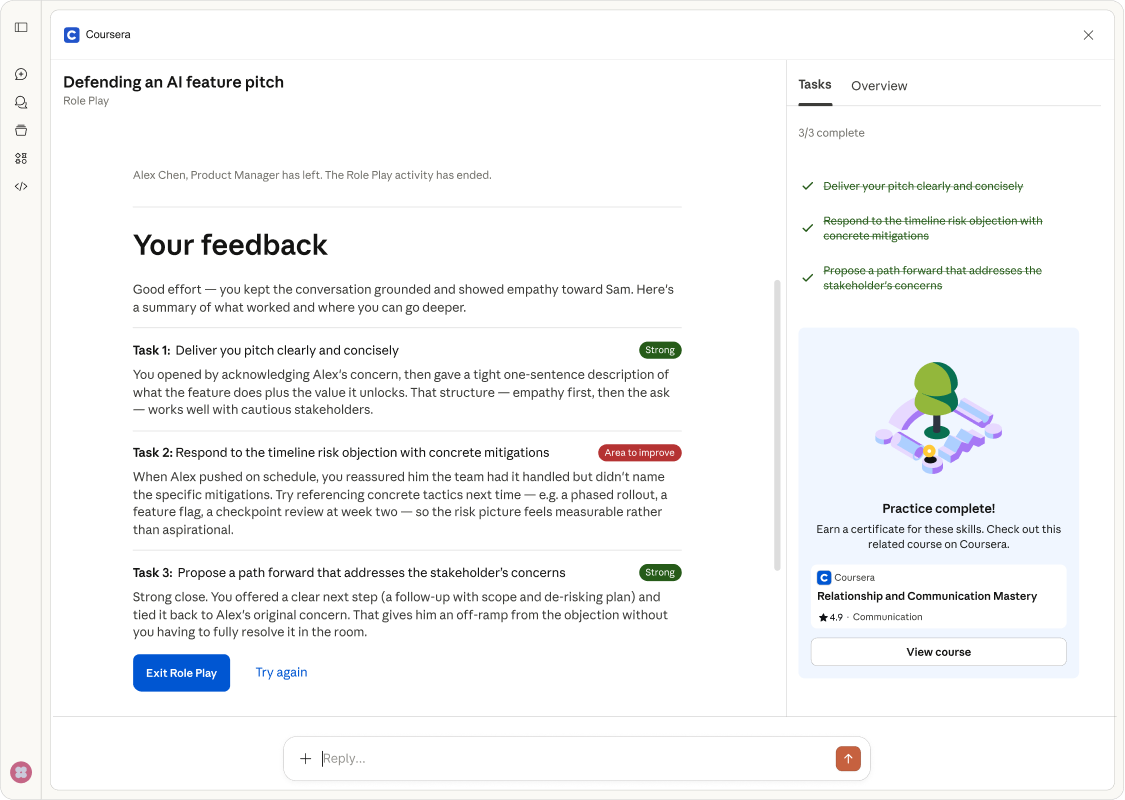
A key consideration was identifying where Coursera could offer unique value beyond Claude's existing capabilities. I explored a range of learning experiences and helped narrow the initial release to personalized role play, using the learner's existing Claude conversation to generate relevant practice scenarios and provide structured, actionable feedback without leaving Claude.
I designed the role-play entry experience, adapted Coursera's existing role-play components to Claude's interface, and created the supporting interactions and flows needed to deliver a cohesive experience. I also helped establish a broader vision for contextual learning within LLMs, laying the groundwork for future expansion beyond role play.
SOLUTION
Strategy & exploration
I began by exploring how Coursera could bring more meaningful learning experiences into Claude, evaluating a range of existing capabilities, including videos, readings, quizzes, assessments, hands-on labs, and role plays.
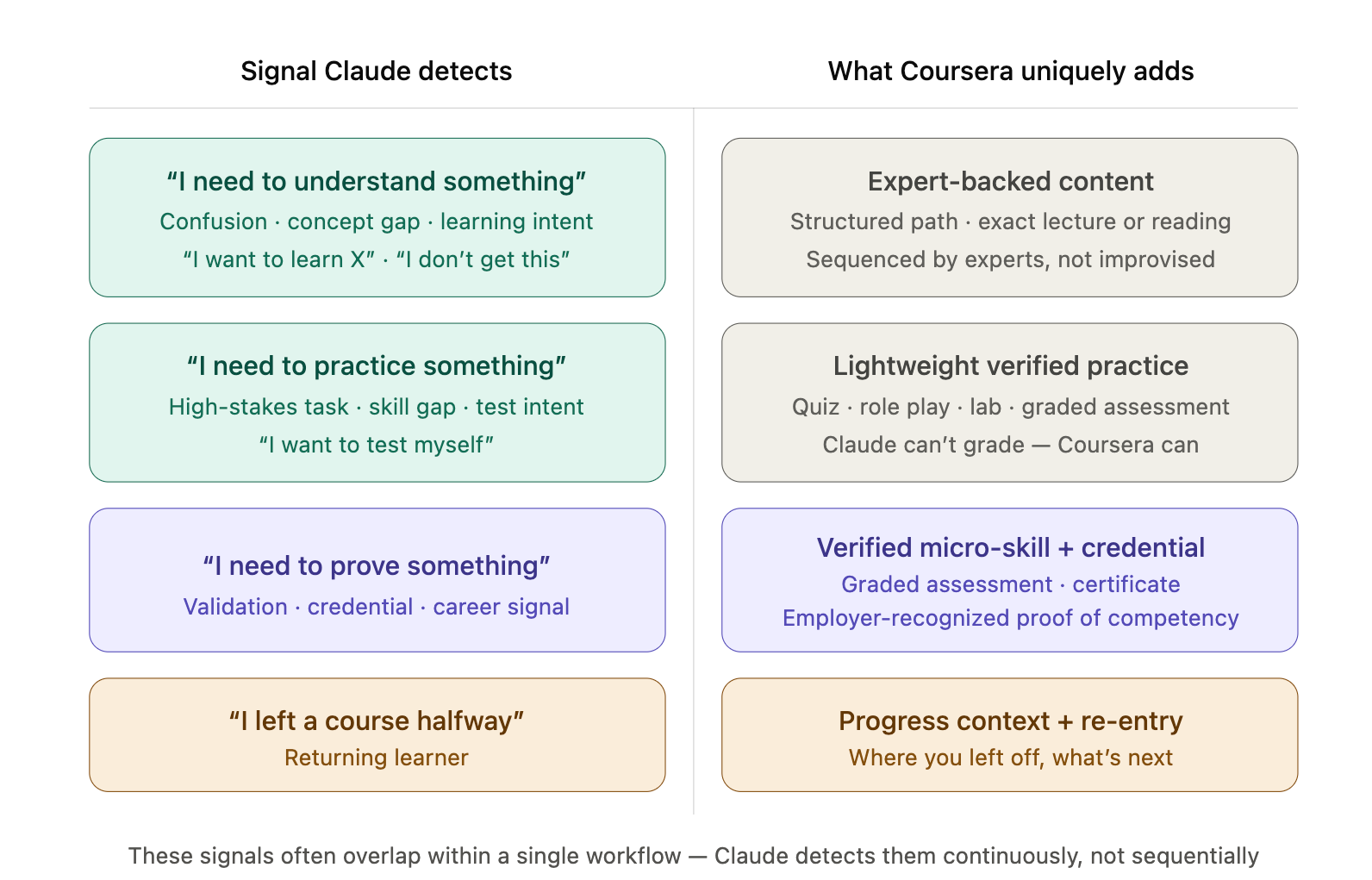
A key consideration was identifying where Coursera could offer value beyond Claude's native capabilities. While Claude could explain concepts and generate practice activities, Coursera offered expert-designed content, structured learning experiences, and meaningful evaluation.
I developed a broader vision for contextual learning, where Coursera could recognize learners' needs within a conversation and surface relevant experiences at the right moment. This included both explicit requests, such as wanting to practice a skill, and implicit signals, such as preparing for a difficult conversation or struggling with a concept.
The vision extended beyond content discovery to helping learners understand, practice, and demonstrate new skills directly within their workflow.
With LLM integrations still a relatively new investment for Coursera, securing executive buy-in required a compelling case for moving beyond course discovery. I brought together insights from our existing integrations, learner-intent mapping, Anthropic's research, and a longer-term product vision to demonstrate both the immediate opportunity for personalized practice and its potential to evolve into a broader learning ecosystem.
I presented this strategic direction to C-suite leadership, securing alignment on the vision and helping establish the foundation for the MVP.
Validating the direction
Before presenting the strategic vision to executive leadership, I reviewed Anthropic's What 81,000 People Want from AI study to evaluate whether the proposed direction aligned with how people were using AI.
The findings reinforced several key opportunities. Concerns about AI reliability (27%) highlighted the importance of trusted, expert-designed content, while concerns about cognitive atrophy (16%) supported a shift toward active skill development rather than passive information consumption.
The research also highlighted the importance of keeping learners in control and connecting learning experiences to meaningful professional outcomes. These insights helped strengthen the strategic rationale for bringing structured, contextual learning into Claude.
Defining the MVP
With a broader vision established, I evaluated which learning experiences could deliver the most meaningful value within Claude while remaining feasible for an initial release.
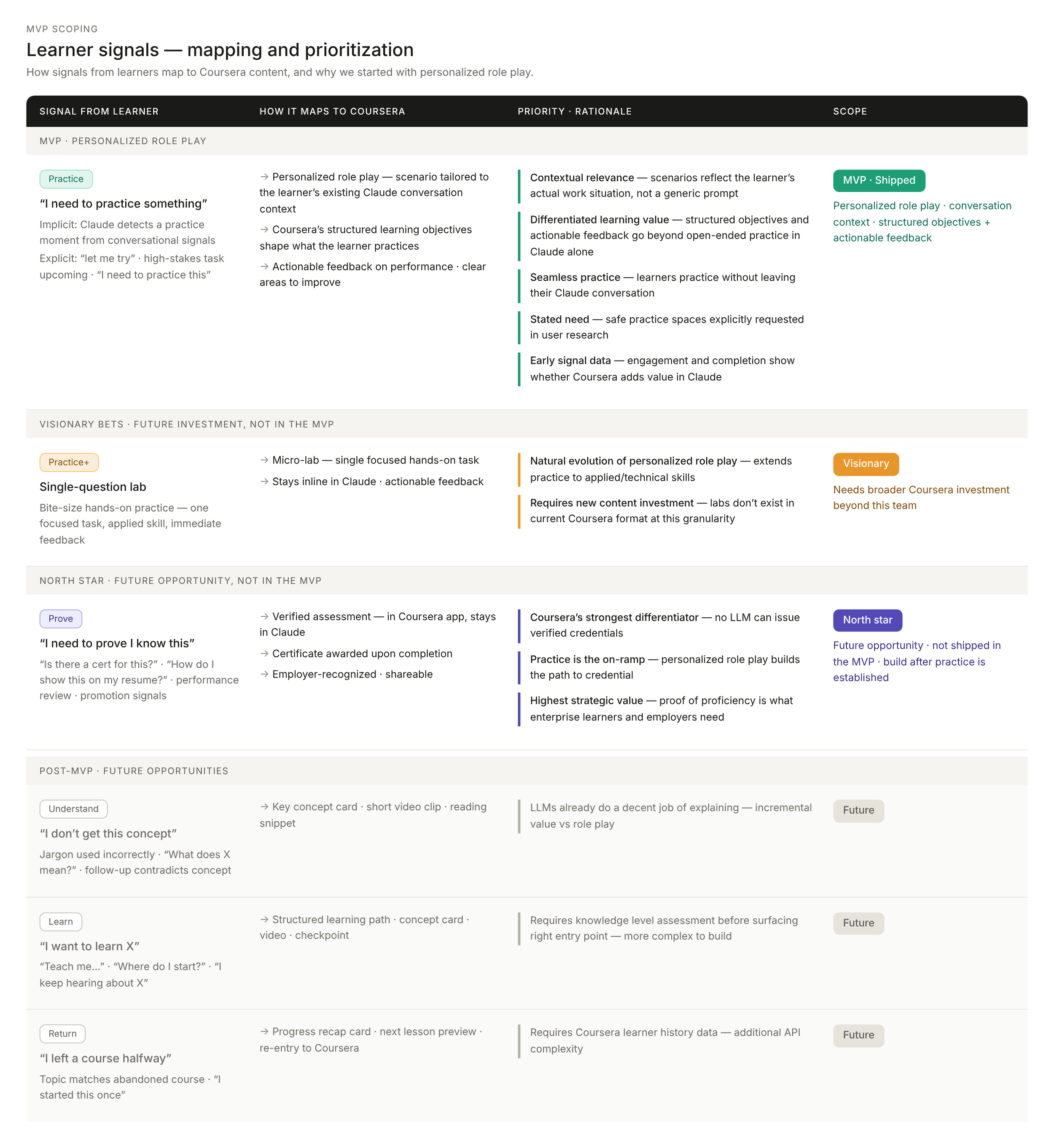
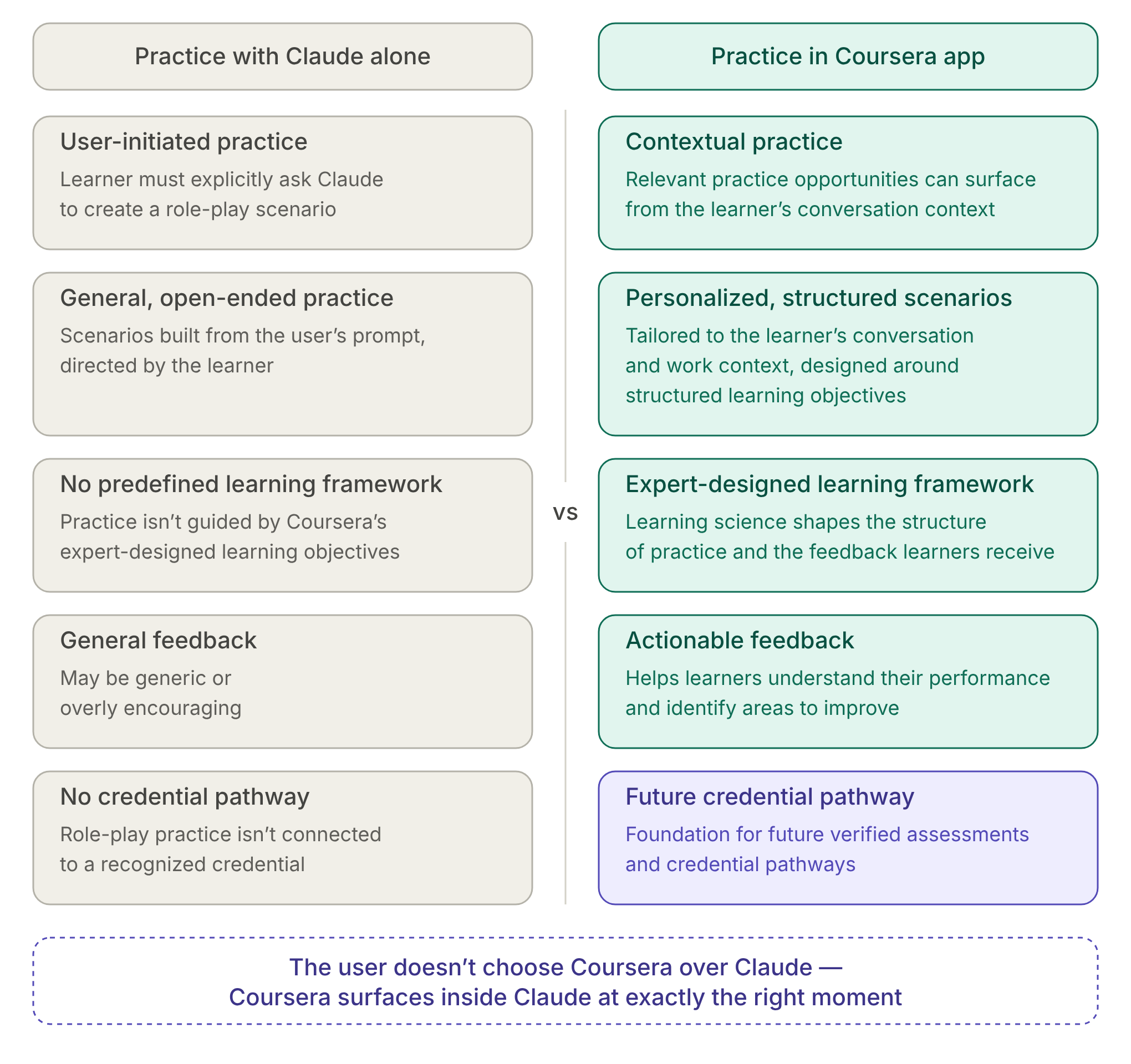
I recommended personalized role play as the MVP because it offered the clearest differentiation from Claude's existing capabilities. While Claude could generate role-play conversations when explicitly prompted, Coursera could offer expert-designed learning objectives, personalized practice scenarios, and structured, actionable feedback to help learners build practical skills.
I developed an MVP recommendation that explored how practice opportunities could surface through explicit requests or contextual signals within conversations. By using the learner's existing Claude conversation to generate role plays on the fly, the experience could make practice immediately relevant to what learners were already working on.
This approach established a foundation for future learning experiences, including hands-on labs, assessments, and verified credentials.
Design & iteration
With the MVP defined, I focused on translating the product vision into a cohesive learning experience that felt native to Claude while preserving Coursera's established role-play structure.
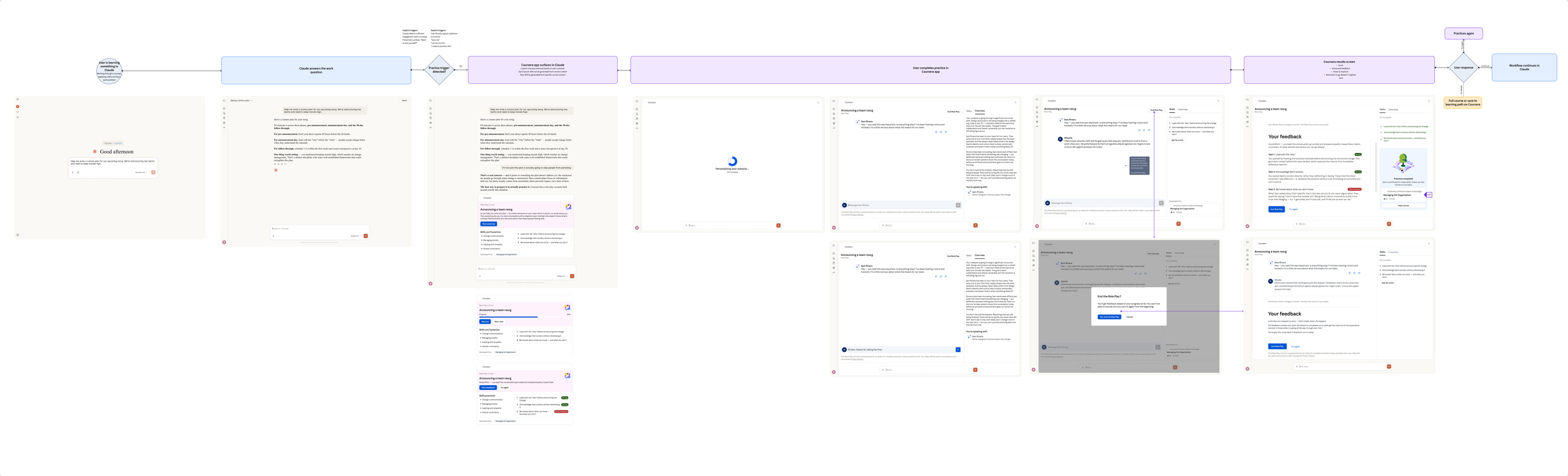
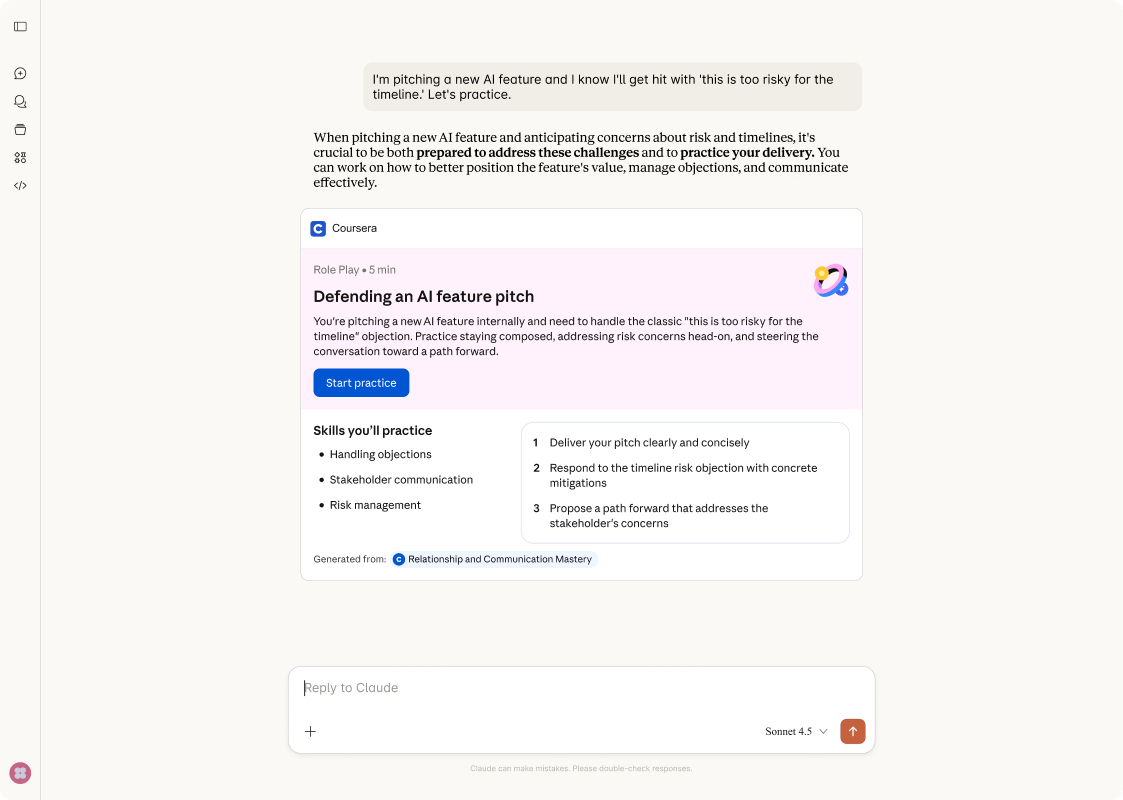
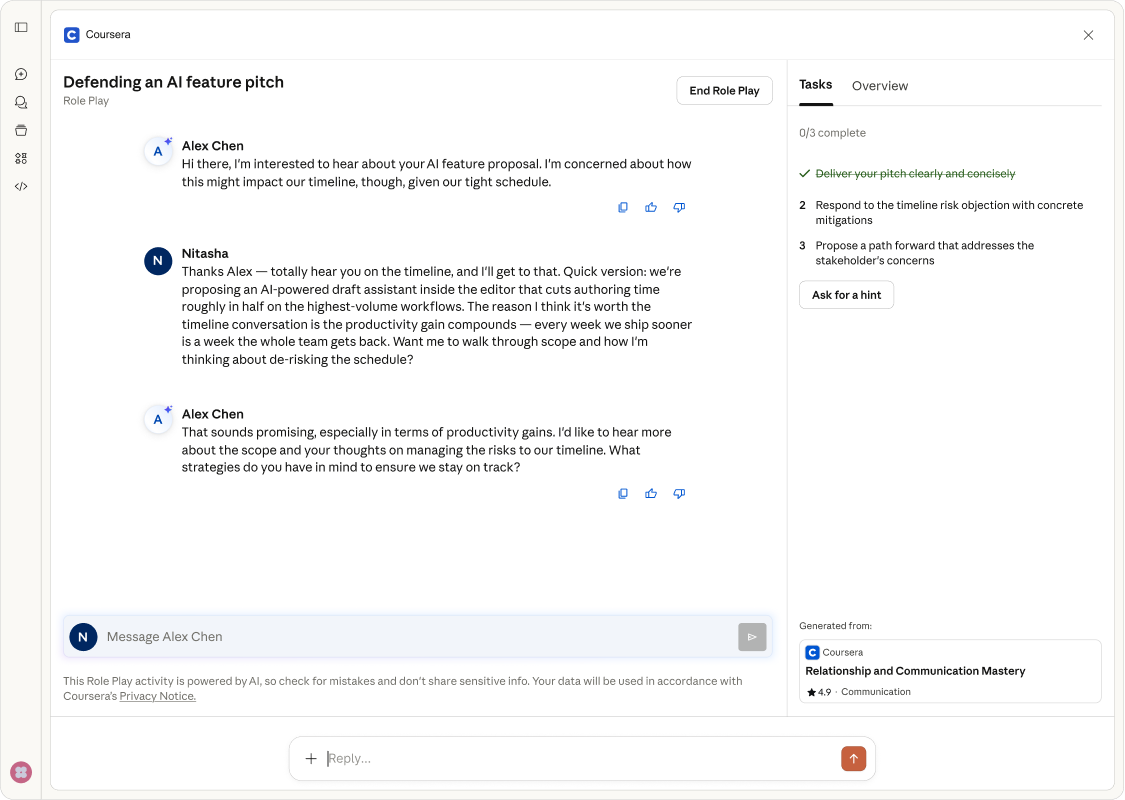
I mapped and designed the end-to-end learner journey, from introducing a relevant practice opportunity within a Claude conversation to generating a personalized role play, completing the exercise, and receiving actionable feedback. I designed the role-play entry card, focusing on how to communicate the value of personalized practice and encourage learners to get started.
Rather than redesigning Coursera's existing role-play experience, I adapted its interface to Claude's visual language and designed the additional components and interactions needed to support a seamless experience within Claude.
User research
During development, I partnered with product and the user research team on a foundational study to better understand how people use LLMs to learn and identify opportunities for Coursera.
The research wrapped up as we were preparing to launch the MVP, and the findings reinforced the product direction. Participants expressed concerns about AI reliability and wanted more structured, interactive experiences that helped them apply knowledge to real-world situations.
A key finding was the need for honest, constructive feedback. Participants described how LLMs sometimes praised incorrect answers rather than identifying mistakes. These findings reinforced the value of Coursera's role plays, which help learners move beyond surface-level understanding through practical application and actionable feedback.
“I don’t know if I can expand on everything like the inner workings of all these MCP servers or whatnot, but I can say what the intended use is.”
Impact & outcomes
The Coursera app in Claude launched on May 18, 2026, bringing personalized role-play practice directly into learners' existing workflows.
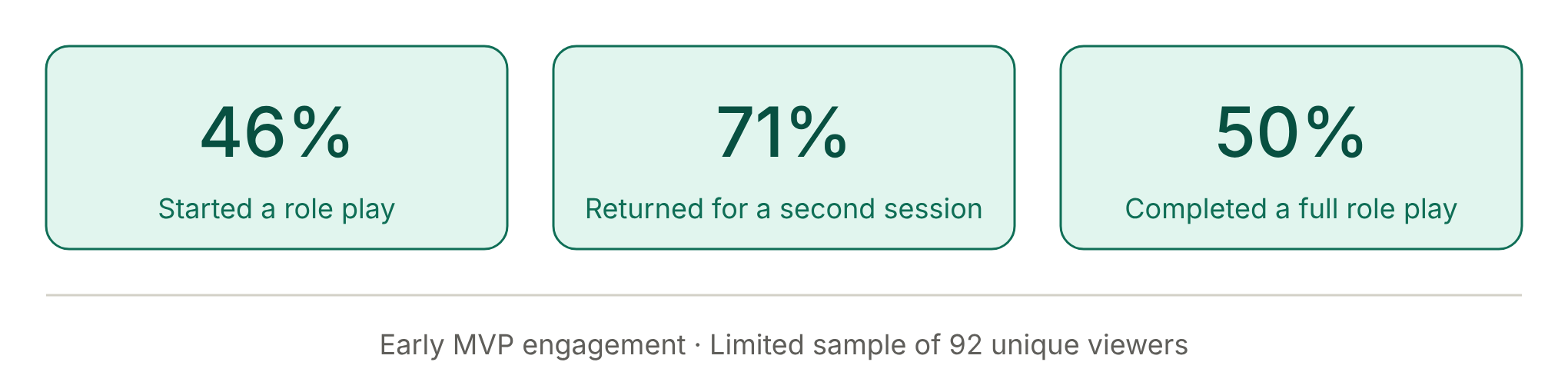
Early engagement showed promising signs of interest, with 46% of viewers starting a role play (42 of 92 unique viewers) and a median time to start of just 13 seconds. Among learners who tried the experience, 71% returned for a second session, and half completed a full role play.
While the initial sample was small, these results provided encouraging early signals that learners were willing to engage with structured, interactive learning experiences directly within an LLM.